

Deconstructing the google brand architecture.
With their corporate mission “to organize the world’s information and make it universally accessible and useful”, the Google brand has proven itself effective in managing its physical brand portfolio.
For a generation who spent our weekends milling over books at the library to finish our school reports, the introduction to the computer in high school and the day google launched itself online were momentous events. I remember having to access the google search engine for University projects but with it being so new, we still had to resort to books to help fill in the blanks. Nowadays google has extended its knowledge base so immensely that one doesn’t even need to buy a dictionary anymore. With google’s corporate mission “to organise the world’s information and make it universally accessible and useful”, the Google brand has proven itself effective in managing its physical brand portfolio.
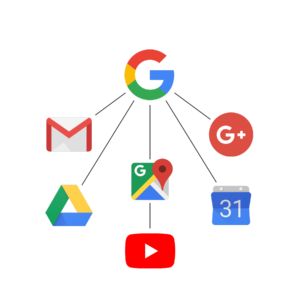
Google products
Starting out as an online search engine they very soon realised that they can make more business by creating specific products that their users could benefit from, so Google developed product extensions of their brand that were to serve as future cash cows, such as Google Mail, Google Maps, etc. all designed in the same visual language and existing under the Google brand as a branded house. This enabled them to grow faster globally and to keep developing a stronger internal culture.
In order to keep up with the ever growing needs of the user, Google branched out with independent products like Fiber and Calico, adding a house of brands archetype to their existing brand architecture. Now even though having 2 brand archetypes in their architecture made marketing difficult, what made things more complicated is that Google started to extend their reach even further by developing products that are not online such as driverless cars, investing in curing diseases, etc. This created confusion as to what Google’s purpose is for the user, and complicated the prospects of crafting a clear road ahead for future business, and industry recommendations for investment banks etc. for Financial Analysts.
These business needs has brought Google to an interesting crossroads which called for a different management approach of their product portfolio. Their solution was to create Alphabet, a holding company that will include all of Google’s products. This allows them to preserve the different product’s as well as the Google brand integrity; to make the brand flexible with room for growth; future proofing their brand architecture, and allowing them to expand their product portfolio to their hearts content.
Alphabet was a smart move if you think about Google’s brand equity. If one of the Google products that form part of the google identity system messes up, it would impact consumer trust in the other products that can be linked to it. Because all do not fall under the Google brand anymore, profitability of the other products now living under Alphabet would remain secure and untouched.
Now even though the Google brand has proven itself effective in managing its physical brand portfolio, managing its portfolio reputation is an entirely different matter. This move was perhaps more strategic than people realise when we look at their current brand reputation. Global criticism ranges from tax avoidance, violation of privacy concerns, fears wether search results are censored, etc. with a growing organised resistance movement that are committed to not use any Google products out of principle.
Considering the above accusations, consumers perspective of Google’s transparency seems pretty bleak. The company has however launched the first in history ‘Google Transparency Report’ in 2010 with which they attempt to address some of the above concerns.
Aside from all the bad press, Google has a strong commitment to ethical practices. “Always keep a relentless focus on the user” these are the words of Sherice Torres, the marketing director of brand studio, googles’s internal marketing leg. Torres is not only responsible for building great brand experiences that connect people with the google brand but also is in charge of crisis response and sustainability. Among many others, these 2 offerings are a large part of Google’s value proposition.
Google CrisisMaps – Crisis response allows Google to help users in disasters by providing info through products like CrisisMaps and they also assist where they can with volunteers as well as gift grants via google.org.
Under sustainability Google tries to do business in a sustainable fashion by creating products that consider our planet’s resources and promoting the building of sustainable workplaces, starting with their own offices as motivation. They also have a sustainability web page dedicated to articles, tools, and reports that will help educate users to be more sustainably minded in their doings.
Building sustainable workplaces at Google – Google states, “from choosing ‘healthy’ materials to reducing waste in our buildings, we’re not only working to provide healthy spaces for Googlers, but also to leave the spaces between the buildings better than we found them.”
In order for brands to survive they need to work on building a great reputation. The online transparency report is great, but they need to specifically address the points where they are not meeting the mark by being solutions driven. One way they could do this is by turning some of the consumer fears into values that specifically counter those fears and being public and transparent in how they implement these values in their product development and company culture. This will rebuild trust and increase consumer loyalty.
Sources.
- https://www.inc.com/marcel-schwantes/googles-insane-approach-to-management-could-transform-your-company.html
- https://www.thinkwithgoogle.com/marketing-resources/organizational-culture/google-marketing-brand-studio/
- https://blog.percolate.com/2015/08/googles-alphabet-steps-up-its-brand-management-game/
- https://abc.xyz/
- https://brandfolder.com/blog/4-branding-lessons-from-googles-alphabet-architecture/